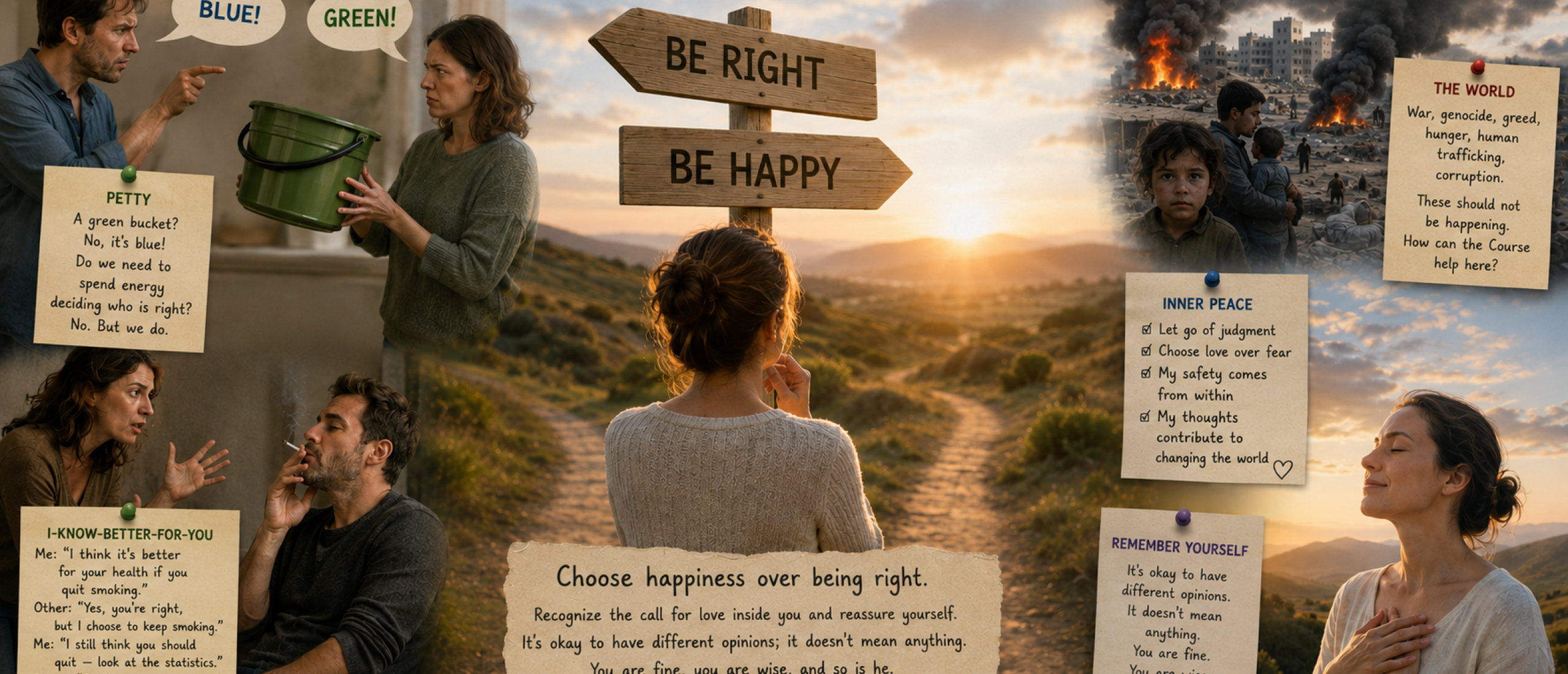
Would you rather be right or happy
Most often I want both. I think many people do. But debates about right and wrong are ego-driven, so even those of us who want to seem spiritually evolved will say, “Of course I want to be happy.” And yet the choice keeps appearing in my life — often over surprisingly petty things. I’ve noticed three levels where this plays out: petty, “I-know-better-for-you,” and the world.
Petty
I asked Paul if he’d seen a green bucket I was looking for. He said no. I found it in the garage and showed him. He said, “That’s not green, it’s blue.” In my mind it was green.
Did we need to spend energy deciding who was right? No. Did we anyway? Yes — briefly, but we did. These little debates — “I think this,” “No, I think that,” “Well, I’m sure that…” — carry no real weight, and yet we cling to them.
Thinking I know what’s better for someone else
I catch myself doing this, too. I tell others how they should eat, spend, speak, or think. The Course is useful here: it says you can change your mind, implying that different thinking yields different results. My ego twists that into “this is how you should think about X, Y, and Z,” and then I’m surprised when they don’t follow my wise counsel.
Me: “I think it’s better for your health if you quit smoking.”
Other: “Yes, you’re right, but I choose to keep smoking.”
Me: “I still think you should quit — look at the statistics.”
Other: “Ok fine, but I’m not going to.”
The world
There are things in this world that feel unacceptable to me: war, genocide, greed, hunger, human trafficking, corruption. I believe these should not be happening. How can the Course help here?
If we look at the result of each level, it’s clear: judgments erode inner peace. Someone else becomes the enemy and seems to hold the power to make me unhappy.
Beneath these examples — even beneath the bucket — is a transferred responsibility. When I insist on being right, I’m really worried about myself. Why do I care about being right for even a minute? What am I asking for? Mostly, acknowledgment. The fear is that I might be wrong, stupid, unnoticed. I want recognition, even if I can’t name the shape it should take.
Choosing happiness over being right Recognize the call for love inside you and reassure yourself. Say: “It’s okay to have different opinions; it doesn’t mean anything. You are fine, you are wise, and so is he.” Drop it.
When I believe I know better for someone else, my “concern” often masks a fear: that someone I care about might suffer, and then what would become of me? I’m not denying genuine care exists — it does — but beneath it may be a personal fear I resist owning.
To choose happiness here requires the same move as with the bucket, plus more courage. I need to face my fears, look them in the eye, and do the inner work that shows my safety doesn’t depend on other people’s choices. My safety is within me. I’m not alone; I walk this world with a loving guide.
What about the world’s suffering? This is harder. I care deeply and often feel powerless wanting others to change. I can participate in social action, state my opinions, and try to make my personal world more awake and loving. But I’ve also come to believe — as the Course suggests — that thoughts shape reality. The outer world reflects our collective thinking.
If I stop seeking power through being right, if I notice where I act from greed or fear for example, and I change the beliefs underlying my thoughts, I change my contribution to the collective. Your thoughts, and mine, can change the world.
This makes me happier than spending my time judging, worrying and making others wrong.